

50+ WMS natively connected. Compatible with 100% of WMS on the market via API or EDI. Integration in under 30 days on average.

Discover the OMS
Orchestrate every order from capture to routing, across channels and sites.
Discover the IMS
Unify your inventory (warehouses, stores, transit, suppliers) into one real-time view.

Discover our Shipping Management
Track every parcel from picking to delivery, across all carriers.

3PL Management
Manage your logistics providers on the same data they see, in real time.

Discover our Workflows & Rules Engine
Automate your business rules with no IT ticket: trigger, condition, action.

Discover our AI agents
Four AI agents connected to your OMS: assistant, detection, data entry, routing.

Discover our Middleware
50+ native connectors and a REST API to plug in your entire ecosystem.
Stand out in RFPs
Walk into 3PL RFPs with a white-label customer portal.
Simpler, more reliable connectivity with my customers
Simpler, more reliable connectivity with my customers and brands.

Give my customers full transparency
Your customers act on orders, incidents and inventory on their own.
Boost productivity on administrative tasks
Double the volume your admin team handles.
Order Management System
The OMS that digitizes your supply chain end to end, from 100K to 10M orders a year.

IMS
Centralize, manage and automate your inventory operations
3PL Control Tower
Outsource logistics without losing control of execution at each 3PL.
WMS Middleware
Connect any WMS and push logistics data out to your entire IT landscape.
Deliver on the customer promise (ATP/ATS)
Show an exact date from the product page, and hold to it.
Manage the supply chain end to end
Aggregate your WMS, TMS, 3PLs and carriers in real time on a single platform.
Orchestrate multi-site flows and inventory
Orchestrate inventory and orders across multiple warehouses and stores.
Manage my logistics providers end to end
A control tower over your 3PLs and carriers, with no IT project.
A digital experience worthy of
your logistics service.
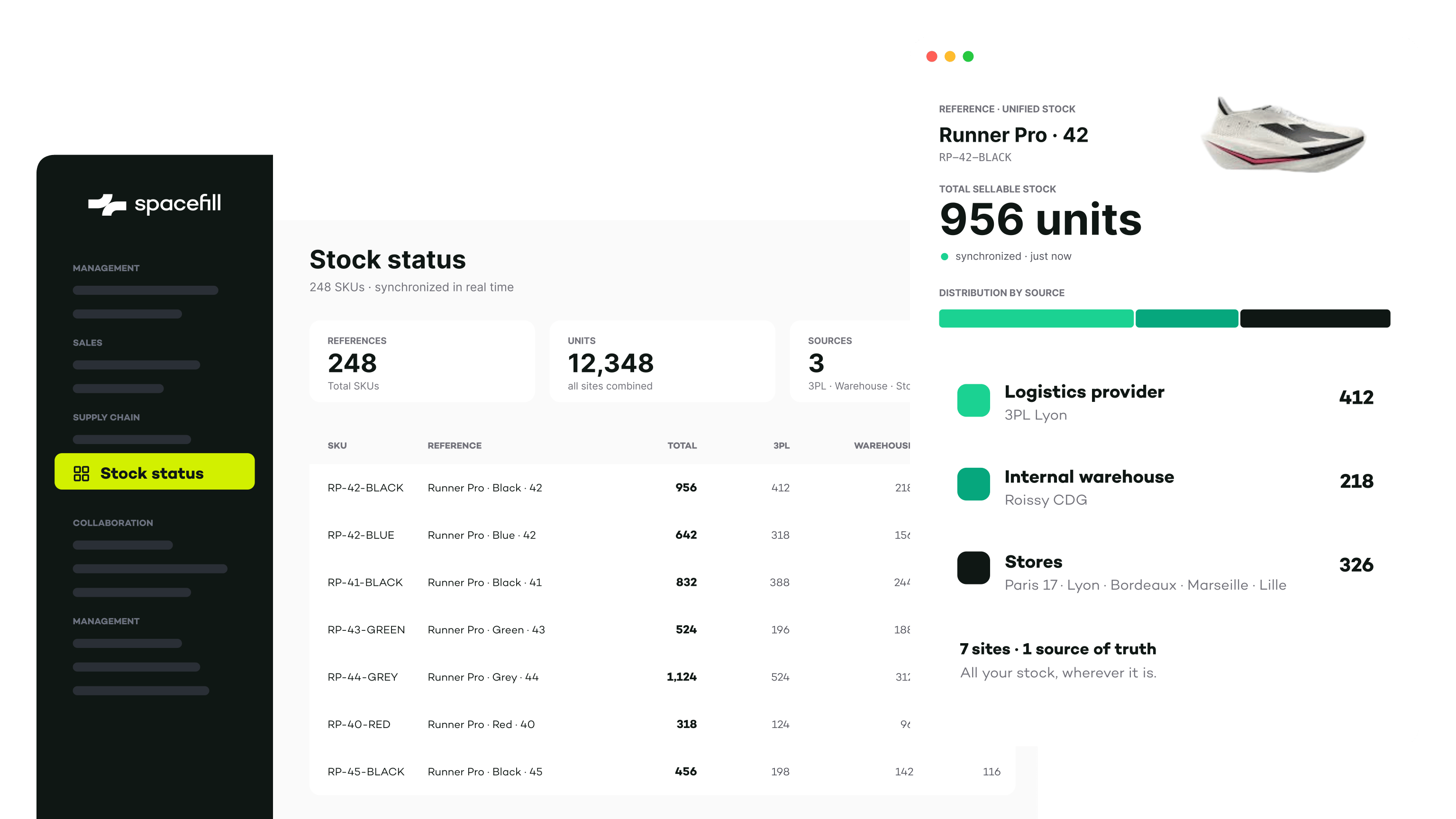
Spacefill 3PL Portal gives your shipper customers the power to act: change or recall an order, report an issue, automate their flows, query their data with AI. White-labelled, under your brand, deployed at 150+ 3PLs across Europe.
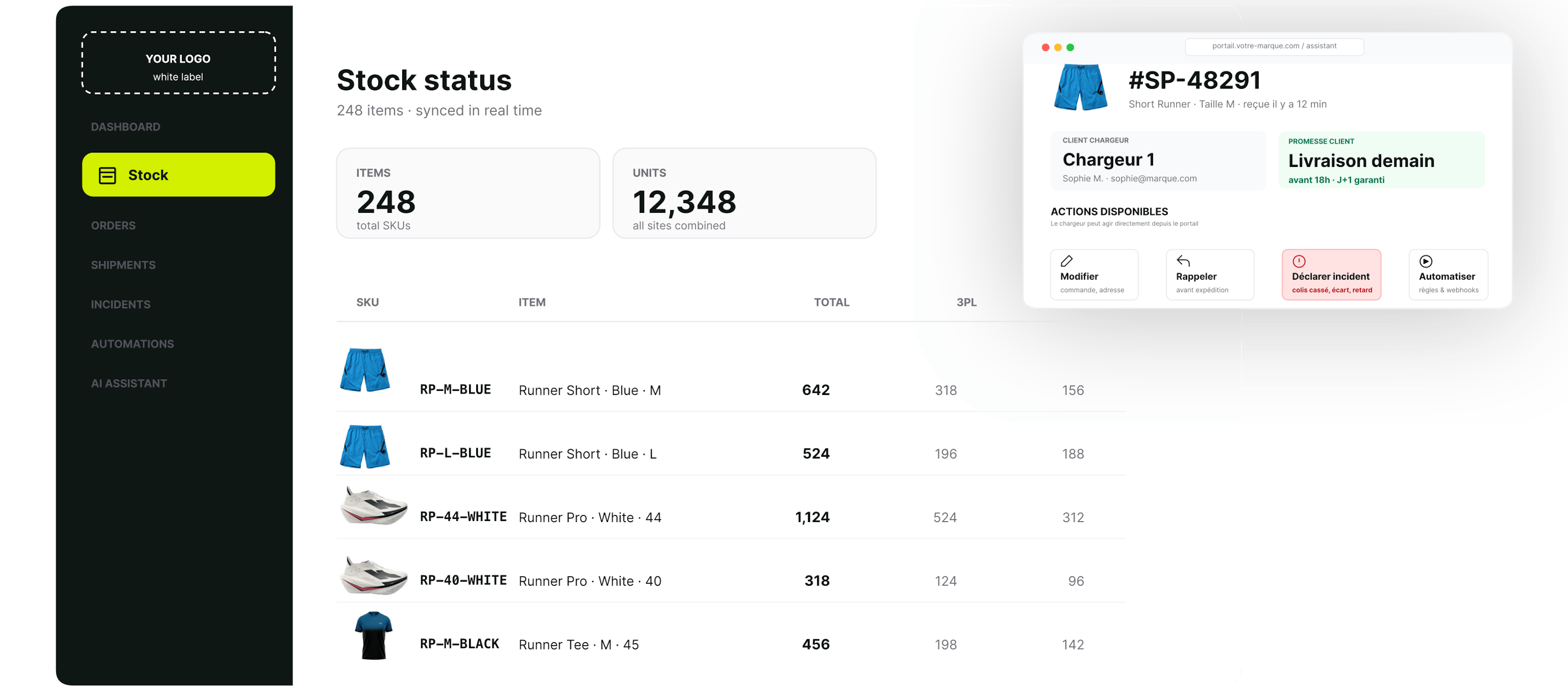
They collaborate with their customers on Spacefill








A different category
A digital experience worthy of your logistics service.
Most portals supplied by WMS vendors are visibility layers: the customer views their stock, reads order statuses, downloads exports.
Spacefill belongs to a different category. It's a true collaboration OMS: your customer acts from the portal, automates their flows, triggers alerts, structures their issues, and queries their data in plain language with AI.

+pts
01234567890123456789
01234567890123456789
customer NPS after deployment
-%
01234567890123456789
01234567890123456789
customer calls and emails
+%
01234567890123456789
01234567890123456789
win rate on tenders
01234567890123456789
weeks to go live
The problem
Your customers don't need a portal anymore. They need a workspace.
Checking an order status is no longer enough. Your shipper customers want to run their logistics from a single interface: act, change, automate, decide. A read-only portal sends them back to their inbox and to your teams.

Every action your customers take goes through you
Changing a quantity, recalling a parcel, flagging a problem: it all comes back as an email, a call, a ticket. Your customer service teams spend more time coordinating than adding value.

Your WMS's native portal is a visibility layer
It displays data, rarely white-labelled, with no business logic specific to the customer. No order changes, no incident workflow, no configurable alerts, and certainly no AI.

Building a real collaboration portal takes years
A portal that enables actions, automation and AI means several years of R&D, a product team, and continuous technical debt. Software publishing isn't your core business.

Digital 3PLs are winning your customers on digital experience
Bigblue, Hive, ShipBob, Everstox, Huboo, ShipMonk: they all arrive with a native customer interface, self-service actions and AI. With no equivalent, you lose tenders you would have won on the service itself.
The solution
Four capabilities that change the nature of the portal
Spacefill 3PL Portal stacks an active collaboration layer, an automation layer and an AI layer on top of a real-time visibility base. All of it white-labelled.

Direct actions
Change, recall or hold an order. Report an issue with attachments. Add a document. The customer acts directly, without emailing the 3PL.
Learn More ➞

Alerts and automation
Stock thresholds, delays, issues, SLAs. Configurable business rules that trigger actions with no human input. Each customer sets their own scope.
Learn More ➞

Conversational AI
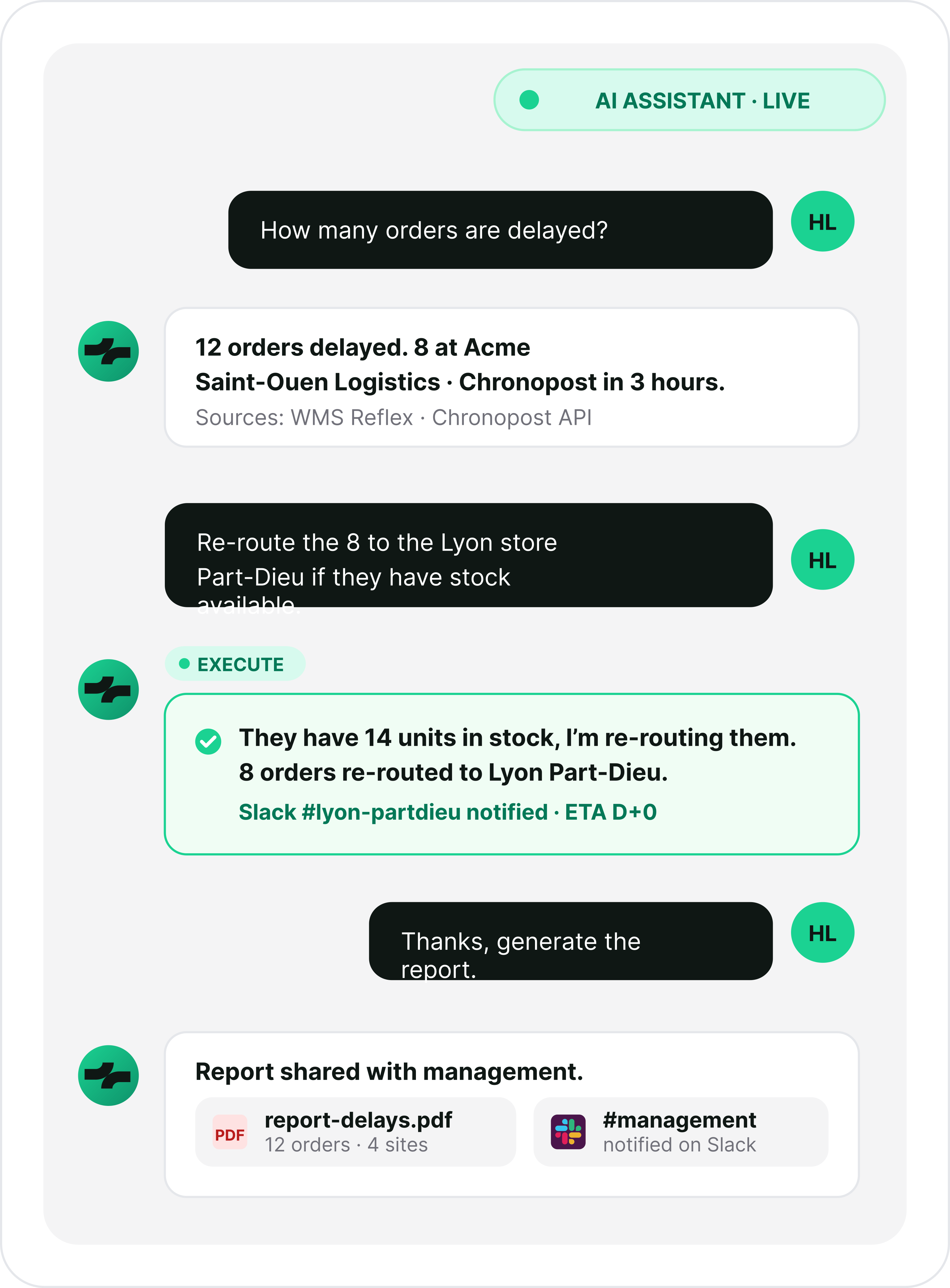
Query your data in plain language, trigger actions from the chat, generate reports on demand. AI makes the platform usable by everyone, not just experts.
Learn More ➞
Full white-labelling
Your logo, your colours, your domain name, your transactional emails. No Spacefill branding on the customer side. The portal becomes a natural extension of your service.
Learn More ➞
Active collaboration
What your customers do in the portal every day
Change and recall orders
The customer changes a quantity, updates an address, recalls a parcel before shipment. The request lands straight in your operations, with no back-and-forth by email.
- Pre-ship changes to order lines
- Order recall with a traced reason
- Flow holds and releases
- Configurable automated rules
↩ Recall ORD-88445 · 14:32 by the customer
Report and document issues
The customer opens an issue from the order concerned, attaches photos and documents, and follows the resolution in a workflow shared with your teams.
- Issue created from the order
- Attachments: photos, reports, invoices
- Workflow shared between 3PL and customer
- Full history for disputes
📎 3 photos + 1 report attached · Issue #4821
Attach documents to orders
Specific delivery notes, customs documents, picking instructions: the customer attaches whatever they need to their orders, and your teams access it as soon as the order is picked up.
- Documents attached to the order or the line
- Customer-specific instructions
- Supporting documents centralized
- Full traceability per document
📎 DN_VENDOME_88432.pdf added
Configure custom alerts
Stock threshold, picking delay, SLA at risk, open issue. Each customer defines their own alerts and picks their channel: email, Slack, Microsoft Teams.
- Alerts by SKU, by customer, by site
- Email, Slack, Teams and webhook channels
- Daily or weekly digest
- Automatic escalation by criticality
⚡ Stock alert < 200 units on SKU-42 · Slack
Automate flows and business rules
Orchestrate a rule on every logistics event: conditional hold, routing, reallocation, escalation. The customer builds their own automations, with no development.
- Business rules on orders, stock and issues
- Conditional holds and releases
- Automatic routing and reallocation
- 20% of orders handled through automated rules
⚙ If delay > 24h → automatic issue + Teams alert
Process unstructured orders
A customer sends their order as a PDF or CSV by email? Smart Order AI reads it, structures it, and passes it to the WMS. No more double entry, no more transcription errors.
- Automatic reading of incoming emails and PDFs
- Structured and sent straight to the WMS
- Anomaly detection before integration
- Works on non-EDI B2B flows
✨ 12 PDF orders processed this morning · 0 manual entry
Artificial intelligence
All of logistics, in plain language.
Spacefill 3PL Portal includes a conversational AI that lets your customers and your teams query data, trigger actions and generate reports without knowing the interface. The AI is connected to your stock, your orders, your issues and your workflows. It replaces dozens of clicks with a sentence.
- Query data in plain language. "How many orders are late this month?", "Remaining stock on SKUs A, B, C", "Which issues have been open for more than 48 hours?"
- Trigger actions from the chat. "Recall order ORD-88445", "Create an issue on yesterday's delivery", "Notify the Ops team about the delay"
- Generate reports on demand. "Export my KPIs for the month", "Compare my SLAs quarter by quarter", "List issues by category"
- Strictly partitioned per customer. Each customer only queries their own scope. No other shipper's data is ever accessible.

How it works
From your WMS to a smart customer portal, in four steps
Connecting your WMS
Step 1
Spacefill connects to your WMS through a native connector. Stock, orders, receipts and shipments flow through in real time.
Branding in your colours
Step 2
Logo, colours, domain, transactional emails: the portal takes on your identity. Your customers see your brand.
Activating the modules
Step 3
Active collaboration, alerts, business automation, conversational AI: activated according to your customers' needs.
Opening it customer by customer
Step 4
Each shipper is activated with their own scope. A new customer is up and running in 2 to 3 weeks.
Architecture
Where Spacefill sits in your IT landscape
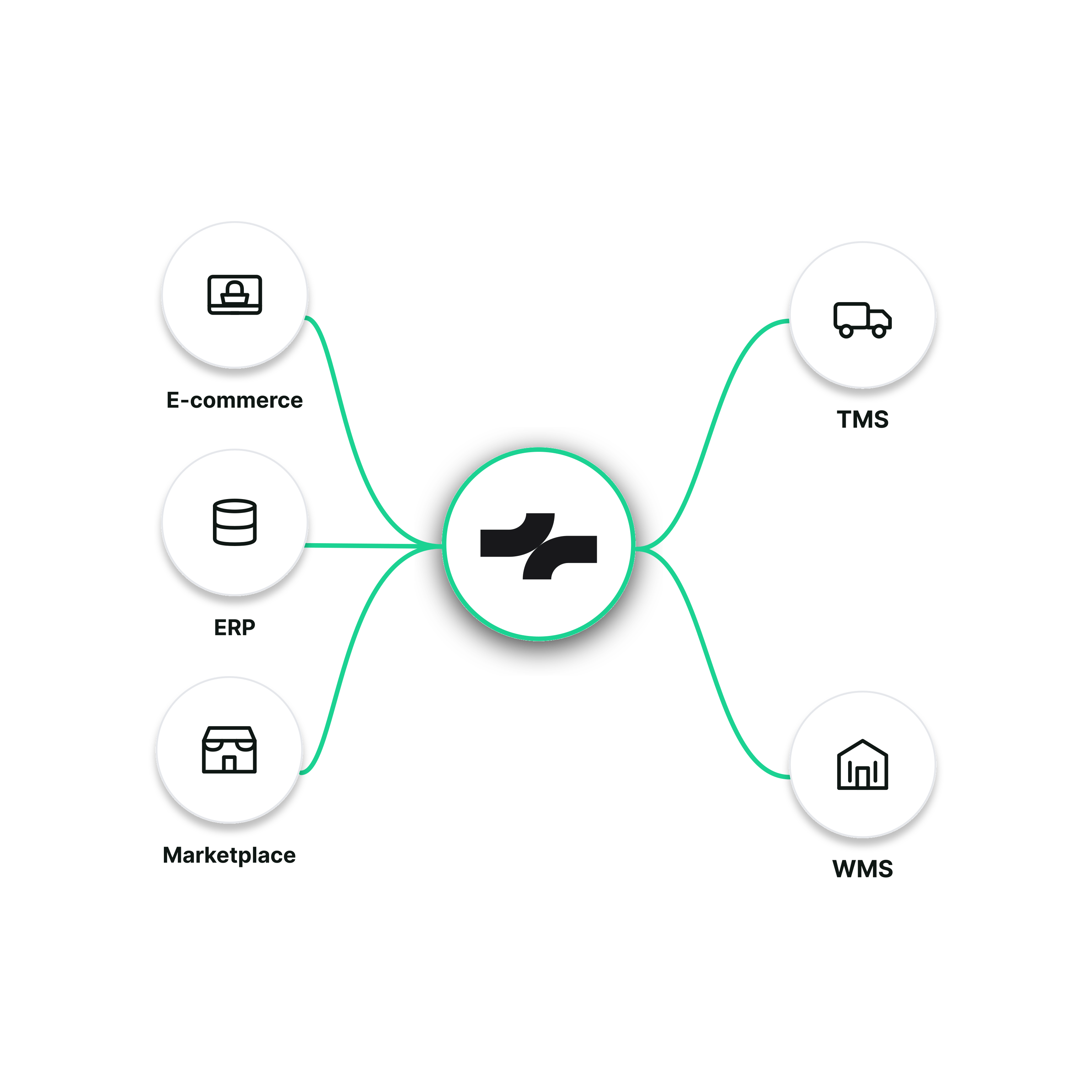
Spacefill is an intelligence and collaboration layer that sits between your WMS and your shipper customers. No replacement, no lock-in, no impact on your internal operations.
Your WMS remains your execution system. Spacefill becomes your customers' smart interface, under your brand.
Customer story
How DERET is digitizing customer relationships across 25+ warehouses
Groupe Deret runs a diverse portfolio of contract logistics customers across 25+ warehouses, with very different profiles: manufacturers, textiles, cosmetics, omnichannel distributors. Each customer has its own requirements for reporting, alerts and incident workflows.
The goal: give every customer a consistent digital experience under the DERET brand, with enough personalization to cover very different use cases. And without tying up an internal tech team.
The portal is deployed white-labelled, with per-customer configuration for KPIs, alerts, incident management and automation rules.
Integrations
Your WMS is probably already in our network



What 3PL leaders ask us

Our WMS already includes a customer portal.
Native WMS portals are visibility layers: the customer views data, rarely white-labelled, with no ability to act or automate. Spacefill doesn't compete with those portals, it plays in a different category: active collaboration, configurable alerts, conversational AI, full white-labelling. That's what your customers are asking for and what digital 3PLs already offer.
We've started building our own portal in-house.
Building a visibility portal is within reach. Building a collaboration portal with actions, automation and AI means several years of R&D, a product team, and continuous maintenance capacity. Spacefill is live in 2 to 4 weeks, with regular product releases including AI. The TCO isn't comparable.
AI is a marketing argument. Does it actually work?
The AI is used in production by customers who query their data and trigger actions every day. It replaces dozens of clicks with a sentence, makes the portal usable by non-technical users, and speeds up recurring tasks like reports and multi-criteria searches. It's strictly partitioned per customer.
We run several WMS depending on the customer.
That's exactly the common case among mature 3PLs. Spacefill aggregates data from multiple WMS into a single portal, with per-customer partitioning. A customer only sees their own data, whatever WMS produced it. Native WMS portals can't do that.
Stop offering a visibility portal. Offer a shared workspace.
3PL Portal questions
Native WMS portals are read-only visibility tools. The customer views stock and order statuses. Spacefill 3PL Portal is an active collaboration portal: the customer can change an order, recall a parcel, report an issue with attachments, configure alerts, trigger automations and query their data in plain language through a conversational AI. It's a different product category.
The customer can change an order before shipment, recall an order in progress, hold a flow, create an issue with photos and documents, attach files to an order, configure custom alerts on stock, SLAs and lead times, set up automations (business rules on orders, stock, issues), export their KPIs, and query their data through a conversational AI. All of it in an interface white-labelled under the 3PL's brand.
Spacefill includes a conversational AI that lets both the shipper customer and the 3PL query logistics data in plain language: stock, orders, deliveries, issues. The AI can also trigger actions (create an alert, recall an order, generate a report). It makes the platform usable by non-technical users and speeds up recurring tasks. Each customer only accesses their own scope.
No. Spacefill sits on top of your existing WMS. It connects natively to Reflex, Effitrace, Infolog, ODATIO, Speed, StockIt and 45+ other WMS. Your WMS remains your internal execution system, Spacefill becomes your collaboration interface with your shipper customers, white-labelled under your name.
Building a smart collaboration portal with AI means several years of R&D, a very high TCO and continuous technical debt. Spacefill is live in 2 to 4 weeks, pre-connected to 50+ WMS, with regular product updates including AI and automation. The 3PL keeps its brand identity without tying up its IT team on a project that isn't its core business.
No. Spacefill is compatible with 100% of WMS on the market via API or EDI. 50+ WMS have a pre-built native connector. For the others, Spacefill teams handle the integration as part of the project, in under 30 days on average.
The portal itself is live in 2 to 4 weeks on the 3PL side. Activating a new shipper customer then takes 2 to 3 weeks on average, depending on the complexity of their flows. Spacefill provides onboarding teams to support the rollout on both the 3PL and the customer side.
The portal is deployed under your 3PL brand: your logo, your colours, your domain name (e.g. portal.yourbrand.com), your transactional emails. No Spacefill branding is visible to the shipper customer. The portal becomes a natural extension of your logistics service.
No. The 3PL subscribes to Spacefill and offers the portal to its customers, white-labelled, as a service included in its offering. It's a commercial differentiator in tenders and a customer retention tool.
After 500+ deployments: 75% fewer WISMO requests, 90% less time spent keying in orders thanks to AI and automation, 75% lower administrative costs on repetitive tasks, 70% less time spent managing issues. Public references: DERET, Ziegler, Orléans Logistique, Prévoté Logistique, Rouxel, Interlog, Thevnet, Joker, Sud Logistique.
Spacefill 3PL Portal is oversized for a provider with fewer than 5 B2B shipper customers, or one handling only pure-play B2C e-commerce flows with no need for structured collaboration. It's built for 3PLs managing a portfolio of shipper customers, where digital experience is a lever for retention and new business.
Spacefill isn't a WMS: it doesn't handle physical operations inside the warehouse. It also doesn't replace the 3PL's billing or payroll systems. The portal is built for customer collaboration and intelligent exposure of operational data, not for internal management of dock teams.