

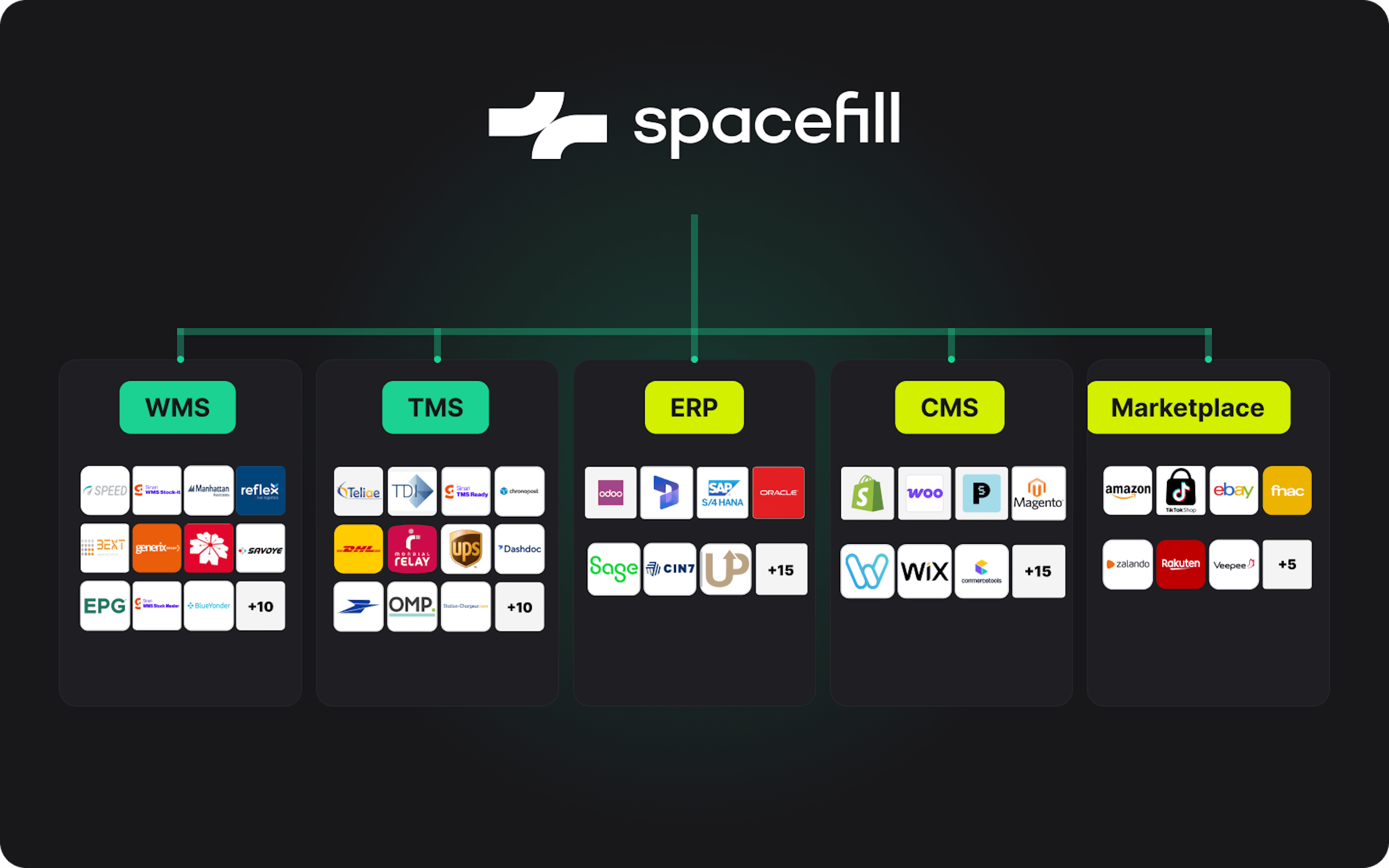
50+ WMS natively connected. Compatible with 100% of WMS on the market via API or EDI. Integration in under 30 days on average.

Discover the OMS
Orchestrate every order from capture to routing, across channels and sites.
Discover the IMS
Unify your inventory (warehouses, stores, transit, suppliers) into one real-time view.

Discover our Shipping Management
Track every parcel from picking to delivery, across all carriers.

3PL Management
Manage your logistics providers on the same data they see, in real time.

Discover our Workflows & Rules Engine
Automate your business rules with no IT ticket: trigger, condition, action.

Discover our AI agents
Four AI agents connected to your OMS: assistant, detection, data entry, routing.

Discover our Middleware
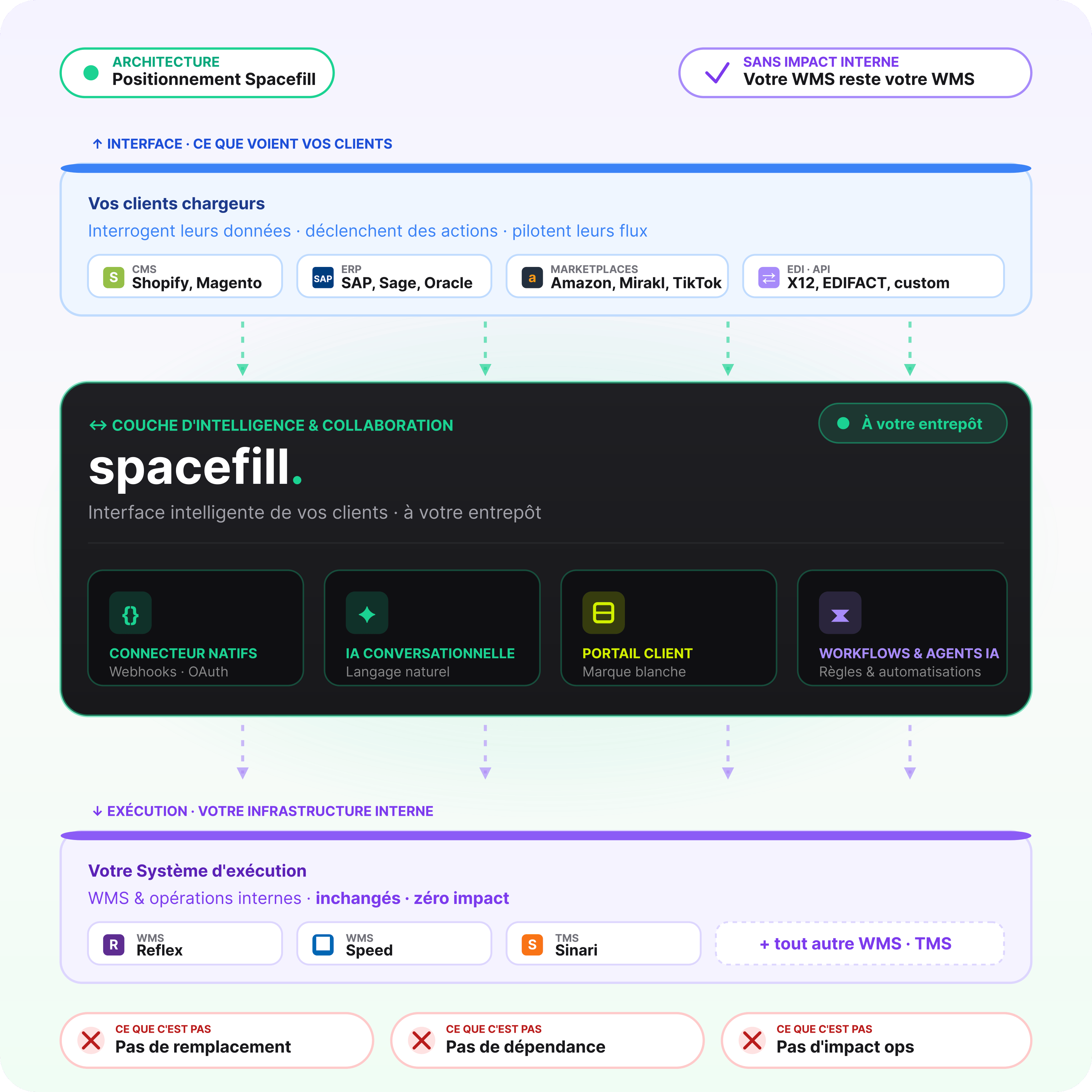
50+ native connectors and a REST API to plug in your entire ecosystem.
Stand out in RFPs
Walk into 3PL RFPs with a white-label customer portal.
Simpler, more reliable connectivity with my customers
Simpler, more reliable connectivity with my customers and brands.

Give my customers full transparency
Your customers act on orders, incidents and inventory on their own.
Boost productivity on administrative tasks
Double the volume your admin team handles.
Order Management System
The OMS that digitizes your supply chain end to end, from 100K to 10M orders a year.

IMS
Centralize, manage and automate your inventory operations
3PL Control Tower
Outsource logistics without losing control of execution at each 3PL.
WMS Middleware
Connect any WMS and push logistics data out to your entire IT landscape.
Deliver on the customer promise (ATP/ATS)
Show an exact date from the product page, and hold to it.
Manage the supply chain end to end
Aggregate your WMS, TMS, 3PLs and carriers in real time on a single platform.
Orchestrate multi-site flows and inventory
Orchestrate inventory and orders across multiple warehouses and stores.
Manage my logistics providers end to end
A control tower over your 3PLs and carriers, with no IT project.
AI that acts on your orders, your stock and your deliveries
AI agents built into the Spacefill OMS, connected to your WMS, ERP and sales channels. They answer your teams' questions, catch issues before the customer does, key in incoming orders and anticipate routing decisions.

-%
01234567890123456789
01234567890123456789
time ops teams spend hunting for information
Spacefill customer average
-k€
01234567890123456789
01234567890123456789
double-entry costs avoided per year (company with €10M revenue)
2024 field benchmark
x
01234567890123456789
faster incident detection before customer impact
Spacefill customer average
-%
01234567890123456789
01234567890123456789
time to handle a logistics ticket with AI context
OMS market benchmark
01234567890123456789
01234567890123456789
01234567890123456789
of supply chain teams have access to data in plain language
Spacefill platform standard
The problem
Supply chain teams spend their days hunting for information, keying in orders and putting out fires
The OMS holds the data. Teams spend their days looking for it, re-entering it, cross-checking it against other sources. The problem isn't technological, it's organizational: too much information, not enough action. That's exactly what AI agents are there to fix.

Getting to the right information takes longer than acting on it
"Which B2B orders are late?" "Which 3PL performed best this quarter?" "How many disputes on the German marketplace?" These basic questions mean clicking through ten screens, exporting three files and cross-referencing the data by hand. Teams spend 40% of their time building the view, not acting on the situation.

Issues surface too late, once the customer has already complained
The 3PL fell behind during a peak, the carrier missed a round, a critical SKU dropped below its threshold: all of it is detectable in the data, but nobody sees it in time. The result: teams work reactively, never proactively. Every issue costs 3 to 5 times more to resolve downstream than upstream.

Purchase orders arrive as PDFs, Excel files and emails, and someone re-keys them
On B2B flows, a share of orders still comes in unstructured: scanned PDFs, non-standardized Excel files, emails with references in an attachment. Someone spends their days opening them, interpreting them, re-entering them into the WMS. For a company with €10M in revenue, that represents between €30,000 and €80,000 a year in invisible costs.

The rules engine runs, but nobody has time to tune it
Routing rules have been frozen since go-live. Six months later, one site is oversaturated, another underused, and nobody has time to analyze why. Logistics costs drift while teams lack the tools to react.
What changes
Five situations. The same agents.
Real cases supply chain, support and leadership teams recognize instantly.

Reporting: SQL export + Excel
Getting a report on quarterly delays by 3PL means an SQL export, an Excel file, and two hours of cross-referencing.

An answer in plain language
One plain-language question to the assistant: "Quarterly delays by 3PL". Report generated in three seconds, right in the conversation.
Issue reported by the customer
Issues surface through the customer calling support, 48 to 72 hours after it was still possible to act.
Detection before shipment
The detection agent spots the anomaly before shipment, creates the ticket, routes it to the right team, with the context needed to resolve it.
Purchase orders re-keyed by hand
B2B purchase orders received as PDFs are re-keyed by hand into the WMS. One person full-time on high volumes.
AI capture, human validation
The capture agent reads the PDF, extracts the order, pushes it to the WMS. A person validates the ambiguous cases, nothing left to re-key.
The problem
Supply chain teams spend their days hunting for information, keying in orders and putting out fires
Spacefill agents are used by different teams, with different objectives. Here are three typical setups among the most common across our customers.
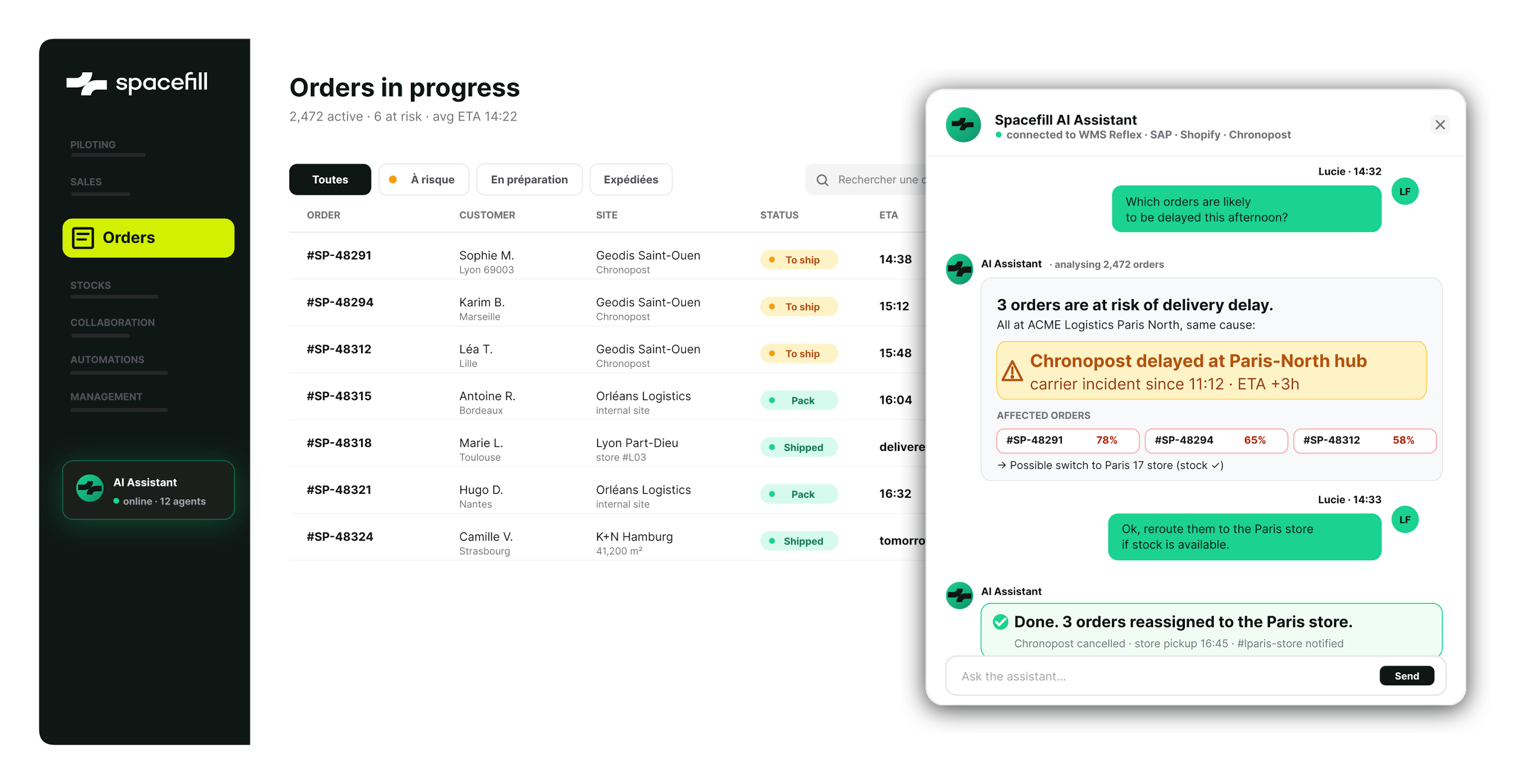
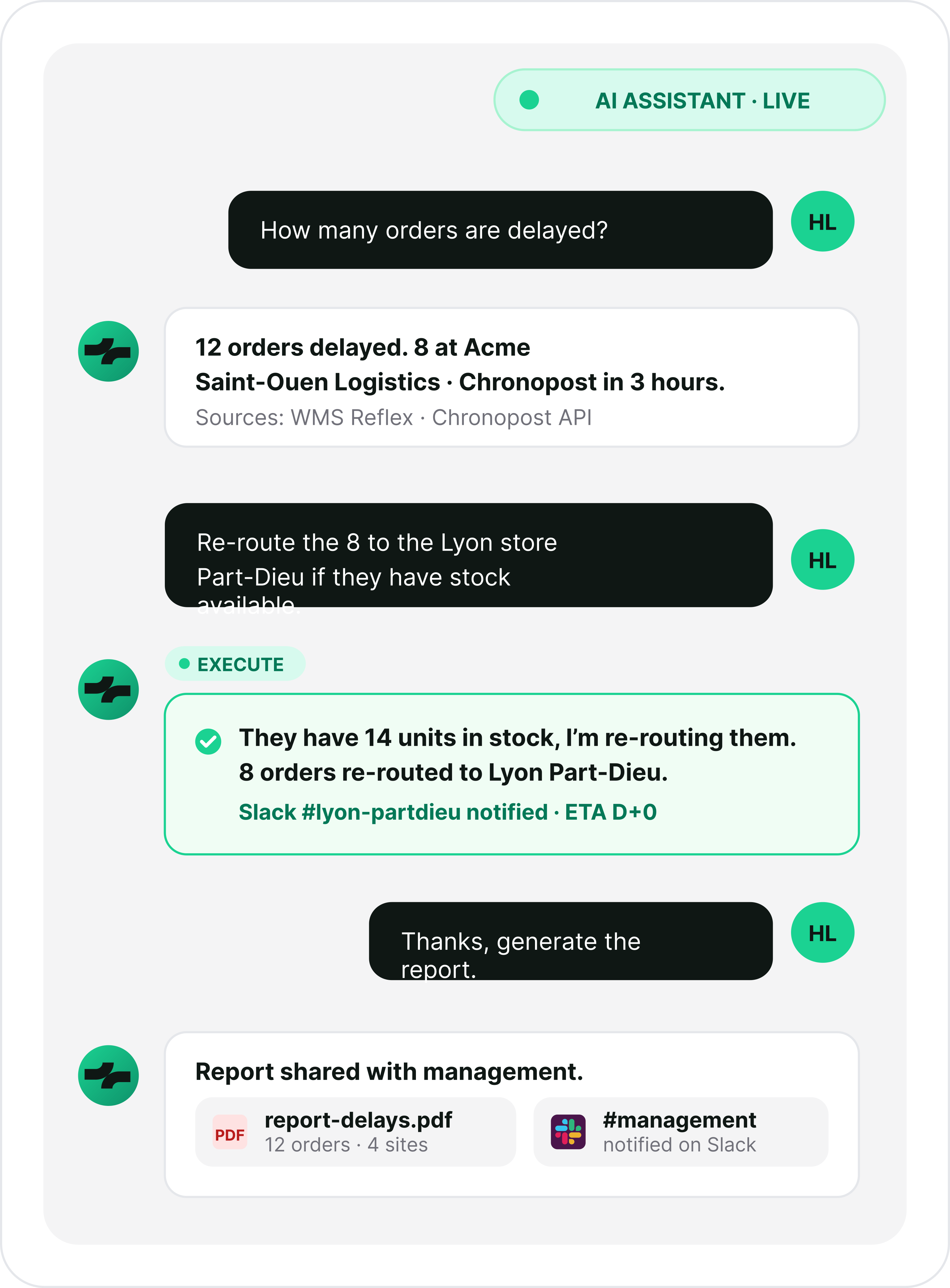
Conversational assistant
Ops, support and leadership teams ask questions in plain language, access the data, generate reports and trigger actions. Inside the OMS, Slack, Teams, Zendesk or Gorgias.
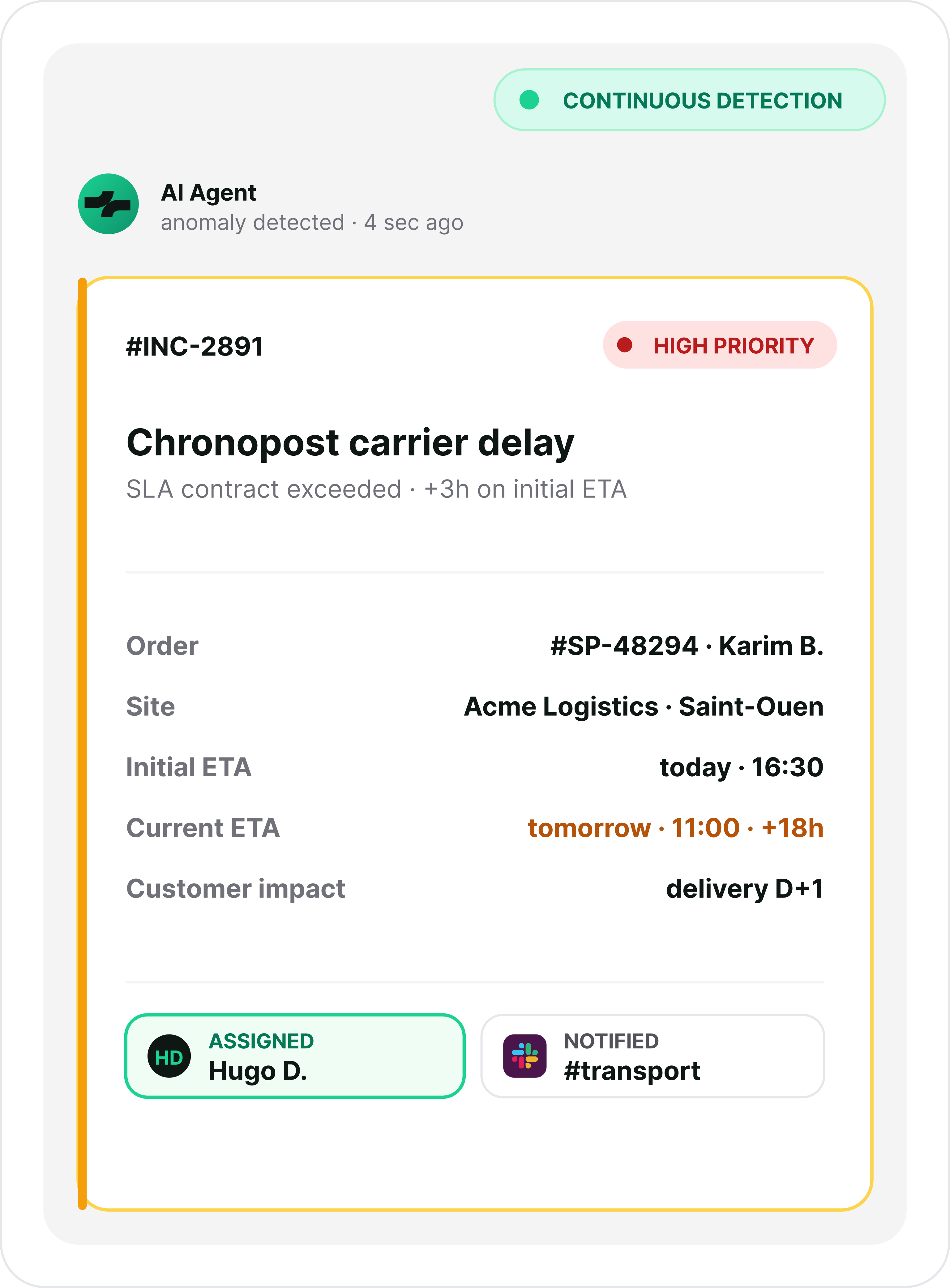
Issue detection + automatic ticketing
The agent continuously scans orders, contractual SLAs and logistics flows. As soon as an anomaly is detected, it creates a pre-qualified ticket, enriches it with context and routes it to the relevant team.
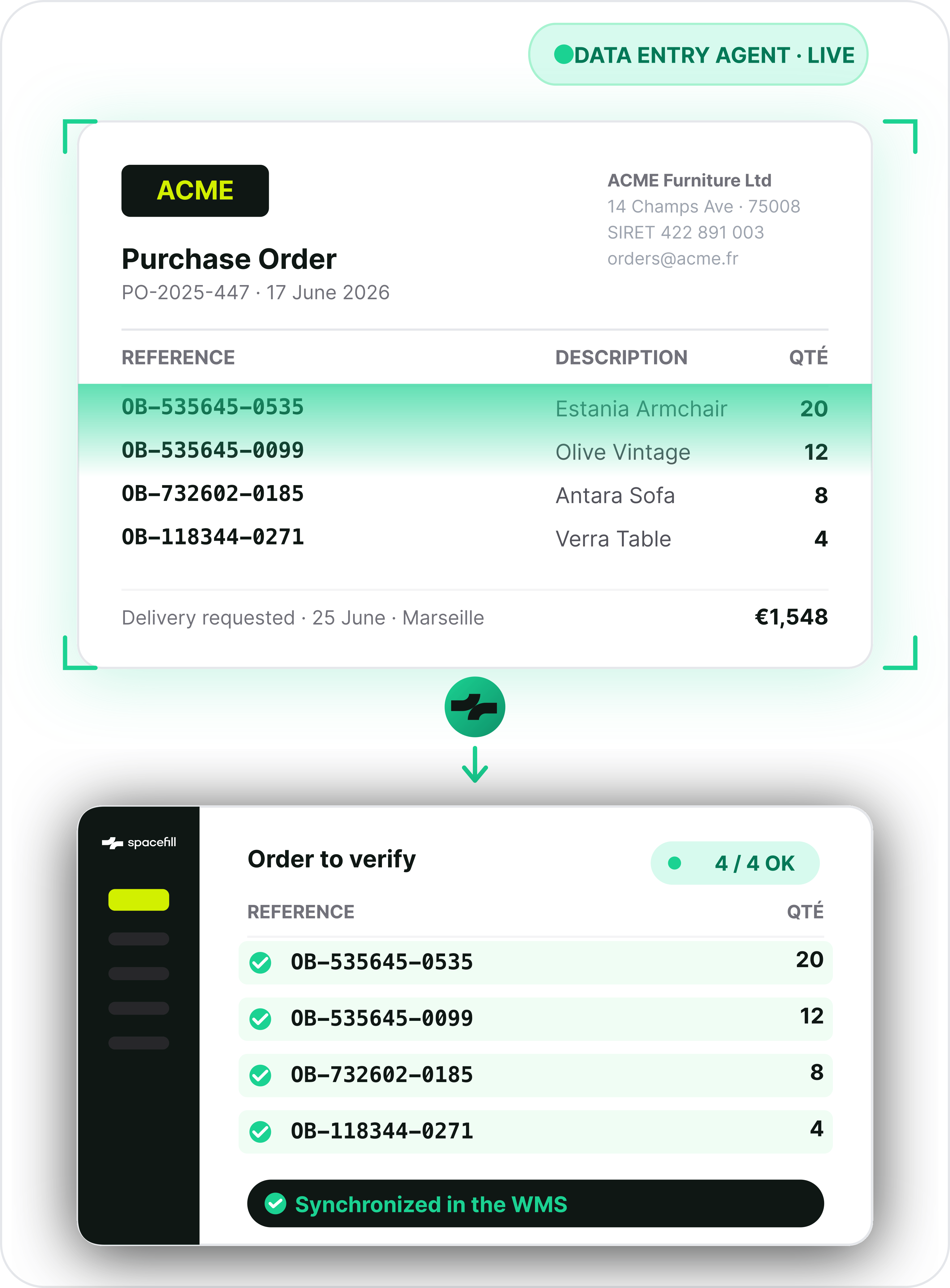
Automatic order capture agent
The agent reads incoming orders in unstructured formats (PDF, Excel, email), extracts the relevant fields, reconciles them against your customer master data and pushes them straight to the target WMS or 3PL. Ambiguous cases go to human validation.
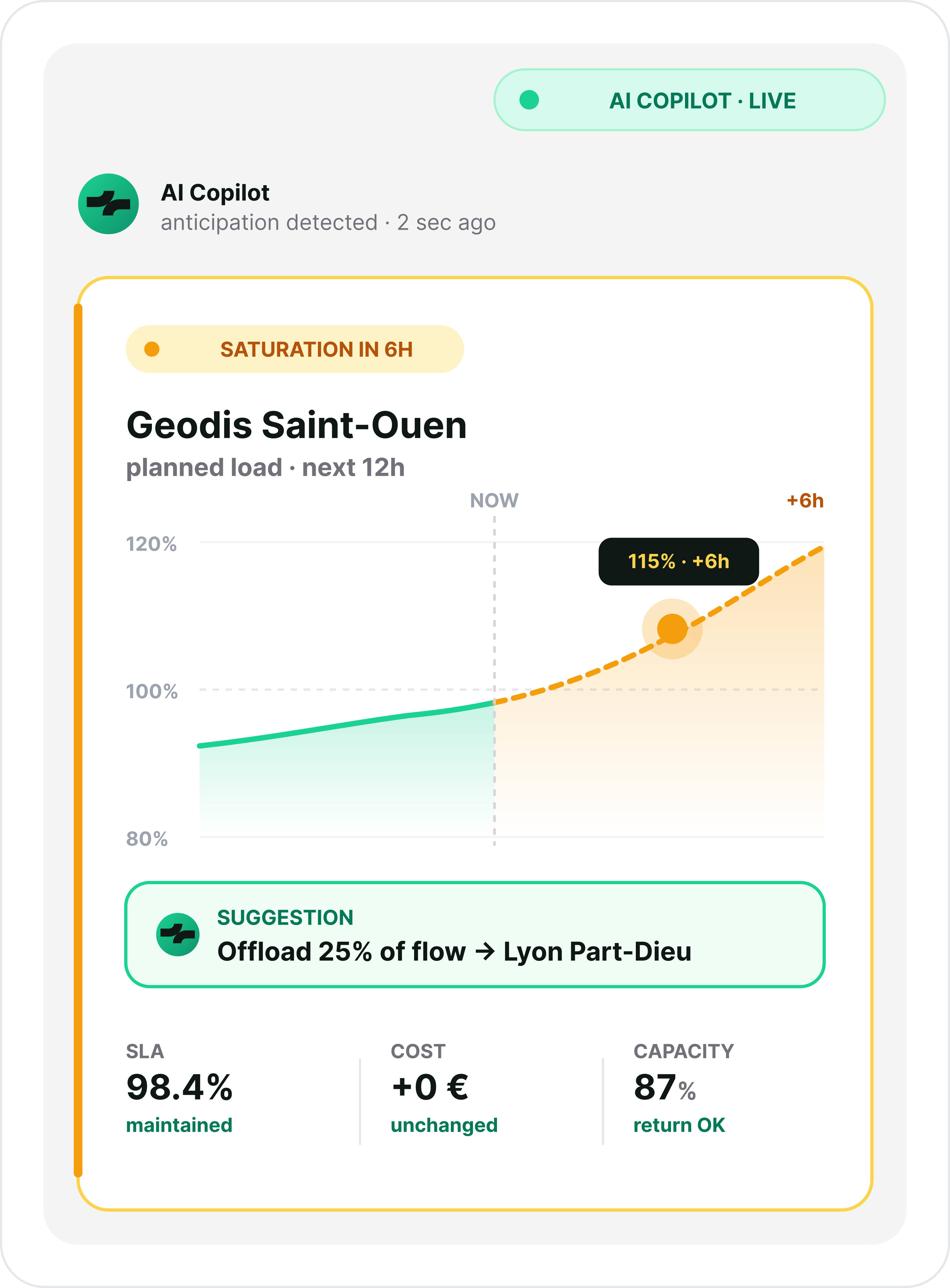
Predictive routing copilot
The agent analyzes historical patterns of load, SLA and cost to anticipate saturation and suggest adjustments to your routing rules. A human validates, the agent applies.
What the agents actually change
-%
01234567890123456789
01234567890123456789
time ops teams spend on reporting
-%
01234567890123456789
01234567890123456789
time to handle a logistics support ticket
x
01234567890123456789
faster incident detection before customer impact
01234567890123456789
01234567890123456789
active agents, in French and English

Integrations
Your WMS is probably already in our network


Frequently asked questions
What people ask before deciding
Three recurring objections, direct answers.
"There's AI everywhere right now. What actually changes?"
Nothing, if the AI isn't connected to real data. At Spacefill, the agents aren't a generic LLM bolted onto a CRM. They're natively connected to the OMS, to your WMS, ERPs and sales channels. They answer from real logistics data and can trigger actions on it. That integration is what makes the difference, not the model.
Agents pre-trained on logistics data
"Will our data be used to train a public model?"
No. Customer data stays isolated, is never used to train shared models, and meets GDPR requirements. The OMS access rules apply to the agents: through the assistant, a user only gets what they would have seen in the interface. No data leaves the Spacefill contractual perimeter.
Per-customer isolation, GDPR compliant
"We don't want AI making decisions for us."
Spacefill agents don't have to decide for you. Each agent has a defined scope: the assistant answers and executes approved actions, the detector creates tickets but doesn't resolve them, the capture agent escalates ambiguous cases, the routing copilot suggests and only applies after human validation. You stay in control at every step.
Human-in-the-loop on critical decisions
Your teams deserve better than dashboards
Other solutions for 3PLs
Questions about Spacefill AI agents
An AI agent is a software module able to perceive, decide and act on operational data without human input at every step. In the Spacefill OMS, agents are wired into your orders, stock and logistics flows: they answer your teams' questions, detect anomalies, create tickets, process incoming orders and support routing. These aren't generic chatbots, they're agents connected to your OMS in real time.
Four broad families of actions are covered so far. A conversational assistant for ops, support and leadership teams, able to answer in plain language, generate reports and trigger actions. Proactive issue detection with automatic ticket creation routed to the right team. Automatic capture of incoming orders (PDF, Excel, email) into the WMS. A routing copilot that suggests the best allocation by anticipating saturation.
Yes. The assistant is available directly in the Spacefill interface, and also from Slack, Microsoft Teams and support tools like Zendesk and Gorgias. Teams can ask questions about orders, stock and SLAs, and trigger actions without switching tools.
The agent identifies the structure of the incoming document (PDF purchase order, email, Excel table, attachment), extracts the relevant fields (product references, quantities, delivery address, requested date), reconciles them against your customer master data and pushes the order straight to the relevant WMS or 3PL. Ambiguous cases go to human validation, everything else is processed with no re-keying.
Stock shortages before shipment, picking delays against the SLA, parcels stuck at the carrier, gaps between announced and picked quantities, missed B2B delivery windows, deviations on a contractual KPI. Every anomaly triggers a pre-qualified ticket, routed to the relevant team and enriched with the data needed to resolve it.
No. The rules engine remains the backbone of orchestration. The copilot learns from past decisions and load patterns to suggest adjustments: send more volume to a given 3PL, anticipate saturation, smooth peaks. The rules stay under your business teams' control. The agent proposes, the human decides.
A generic model knows nothing about your orders, your 3PL contracts, your business rules or your SLAs. Spacefill agents are built for logistics data, natively connected to your OMS, your WMS (50+ natively), your ERPs and your sales channels. They act on real data while respecting your access rights and governance rules.
The agents ship with the platform. The conversational assistant and the detection agent are operational as soon as the OMS goes live. The capture agent needs initial configuration per type of incoming document (from a few days to a few weeks depending on the variety of formats). The routing copilot starts producing useful suggestions after a few weeks of history.
Yes. Customer data stays isolated, is never used to train shared models, and meets GDPR requirements. The OMS access rules apply to the agents: through an agent, a user only gets what they could see in the interface.